Protocol-Oriented vs Object-Oriented Programming in Swift: What’s Better and When to Use Each
In this article, we’ll go beyond the theory and dive into a side-by-side comparison of Protocol-Oriented vs Object-Oriented Programming in…

🧠 Introduction
If you’ve ever tried to architect a Swift app and found yourself torn between using class or protocol, welcome to the club — we’ve all been there. Swift developers often find themselves at a crossroads: Should you go the traditional route with Object-Oriented Programming, or embrace the protocol-first mindset of Protocol-Oriented Programming?
The truth is, Swift gives you the best of both worlds — and that’s both a blessing and a curse. It’s like being handed both a Swiss Army knife and a katana, and now you’re expected to carve out a beautiful app without stabbing yourself in the foot. 🦶💥
In this article, we’ll unpack the key differences, practical use cases, and real-world advice on when to choose one over the other — or better yet, how to combine them for a more scalable and testable Swift codebase.
⚠️ New to these concepts? No problem — check out the foundations here:
**Mastering OOP in Swift: A Beginner-to-Advanced Guide to Object-Oriented Programming** _🚀 Think you already know OOP? Let’s put it in Swift terms. This beginner-to-advanced guide unpacks Object-Oriented…_medium.comhttps://medium.com/swift-pal/mastering-oop-in-swift-a-beginner-to-advanced-guide-to-object-oriented-programming-5d93432c0a44
**Protocol-Oriented Programming in Swift Explained: How POP Works & Why It Matters** _Think Swift is all about classes? Think again. Dive into Protocol-Oriented Programming (POP) in Swift and learn how…_medium.comhttps://medium.com/swift-pal/protocol-oriented-programming-in-swift-explained-how-pop-works-why-it-matters-ab264a8759ff
Let’s dive into this Swift-style face-off and figure out which approach fits your project best. 🧑💻
⚡ OOP vs POP in Swift — A 60-Second Recap
Let’s face it — no one has time to re-read a whole programming paradigm book before deciding how to structure a view model. So here’s your no-fluff refresher:
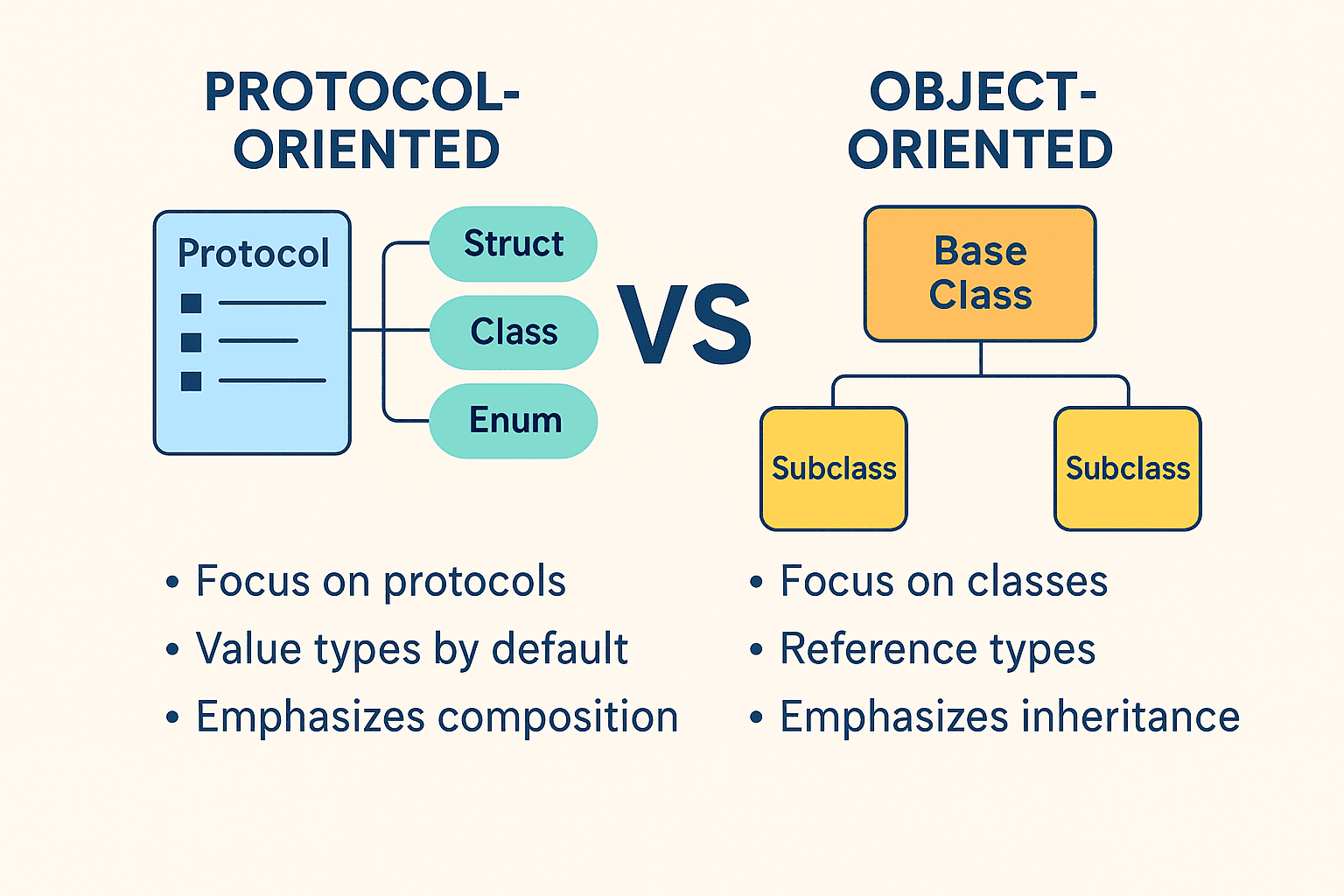
🧱 Object-Oriented Programming (OOP)
- Think classes, inheritance, and shared behavior through base types.
- You model your app using real-world entities, and relationships often follow an “is-a” pattern.
- You’re dealing with reference types — pass them around and they still point to the same instance (hello, side effects 👋).
🧠 Want a full tour of OOP in Swift? Check this out: 👉 _Mastering OOP in Swift_
**Mastering OOP in Swift: A Beginner-to-Advanced Guide to Object-Oriented Programming** _🚀 Think you already know OOP? Let’s put it in Swift terms. This beginner-to-advanced guide unpacks Object-Oriented…_medium.comhttps://medium.com/swift-pal/mastering-oop-in-swift-a-beginner-to-advanced-guide-to-object-oriented-programming-5d93432c0a44
🧩 Protocol-Oriented Programming (POP)
- Focused on protocols, composability, and value types like structs and enums.
- It’s all about saying “what something can do”, rather than what it inherits from.
- Encourages code reuse via protocol extensions and avoids the tight coupling of deep class trees.
🔍 Curious why Apple says Swift is a “protocol-oriented” language? Start here: 👉 _Protocol-Oriented Programming in Swift_
**Protocol-Oriented Programming in Swift Explained: How POP Works & Why It Matters** _Think Swift is all about classes? Think again. Dive into Protocol-Oriented Programming (POP) in Swift and learn how…_medium.comhttps://medium.com/swift-pal/protocol-oriented-programming-in-swift-explained-how-pop-works-why-it-matters-ab264a8759ff
🧱 When to Use Object-Oriented Programming in Swift
Ah yes, good ol’ OOP. It’s been around longer than some of our Stack Overflow accounts, and for good reason. In many real-world Swift apps — especially ones that lean on UIKit, AppKit, or legacy frameworks — Object-Oriented Programming still shines.
Here’s when you might want to reach for classes over protocols:
✅ Use OOP When:
- You need inheritance — like when multiple objects share a common base with default behavior (hello
UIViewController👋). - Reference semantics make sense — e.g., when you want shared mutable state across objects.
- You’re working with UIKit — Apple’s UI frameworks are deeply rooted in OOP.
- You’re building something fast and simple — and protocol composition would feel like overkill.
💡 Real-World Example:
Say you’re building a custom alert system using subclasses of UIViewController. It makes sense to create a base class BaseAlertController, then subclass that for ErrorAlertController, SuccessAlertController, etc. Inheritance gives you reuse with minimal setup — and everyone in UIKit-land knows how to play along.
🔗 Related Reading:
Want to see how OOP fits into scalable architecture? These will help:
**Understanding Clean Architecture in iOS: A Beginner’s Guide** _Tired of Spaghetti Code? 🍝 Let’s Clean Things Up in iOS!_medium.comhttps://medium.com/swift-pal/understanding-clean-architecture-in-ios-a-beginners-guide-69d09b4883c4
**MVC vs MVVM vs VIPER in iOS: Which Architecture Should You Choose in 2025?** _In this no-fluff breakdown, we’ll compare the good, the bad, and the “wait… why is this so complex?” of each…_medium.comhttps://medium.com/swift-pal/mvc-vs-mvvm-vs-viper-in-ios-which-architecture-should-you-choose-in-2025-38386312e0c1
🧩 When to Use Protocol-Oriented Programming in Swift
If Object-Oriented Programming is about who you are, Protocol-Oriented Programming is more about what you can do.
Swift was practically built to make protocols feel like first-class citizens. And when you’re writing modern Swift code — especially in SwiftUI or Combine-heavy apps — POP starts to feel like home.
✅ Use POP When:
- You want composition over inheritance — add capabilities by conforming to protocols, instead of nesting class trees.
- You’re working with value types — structs, enums,
Result,Optional, and SwiftUI’sVieware all value-based. - Testability matters — mocking protocols is easier than mocking concrete classes.
- You want to keep things modular, reusable, and swappable. Traits over types, baby. 💅
💡 Real-World Example:
Imagine you’re building a networking layer. Instead of subclassing a BaseAPIClient, you can define a protocol like RequestPerforming, conform multiple strategies to it, and swap them during tests or different environments. No inheritance. Just clean, reusable logic that plays nicely with struct\-based architectures.
🔗 Related Reading:
**How to Structure a Scalable iOS App with Modular Architecture** _Struggling with messy codebases and slow builds? Learn how modular architecture can make your iOS app scalable…_medium.comhttps://medium.com/swift-pal/how-to-structure-a-scalable-ios-app-with-modular-architecture-b0130da83bca
**Dependency Injection in Swift: A Beginner-to-Advanced Guide** _🧪 Feeling tangled in singletons and tightly-coupled code? Learn how Dependency Injection in Swift can help you write…_medium.comhttps://medium.com/swift-pal/dependency-injection-in-swift-a-beginner-to-advanced-guide-b85378c6f8d2
These concepts pair beautifully with POP and unlock flexibility most class-based designs struggle with.
🌀 Can You Mix OOP and POP in the Same Swift Codebase?
Short answer: Yes. Absolutely. You probably already are.
Swift isn’t opinionated like some hipster languages. It’s pragmatic. It doesn’t force you into one paradigm — instead, it lets you use OOP where it fits, and POP where it shines.
And in real-world iOS apps, you’ll find that blending both leads to the best results.
🍦 Example Time:
Let’s say you have a base class BaseViewController for common setup across your screens (classic OOP move), but you also want all screens to conform to a Loadable protocol that adds a showLoader() method via extension (POP style).
You get:
- Inheritance for shared UIKit lifecycle logic.
- Protocols for reusable, composable behavior across classes or structs.
It’s like using ice cream and sprinkles. 🍨
📦 Why This Works Well:
- Swift’s
UIViewController,URLSession, and friends are OOP-based. - But SwiftUI, Combine, and Swift’s own standard library lean heavily on POP.
- Even Apple mixes both:
Codableis a protocol, but many conforming types are classes.
You don’t need to pick a side — just pick what fits the job.
⚖️ Performance, Testability & Maintainability
Let’s be honest — no one picks a programming paradigm just for philosophical reasons. At the end of the day, it’s about writing code that’s fast, testable, and won’t fall apart the moment you look away.
Here’s how OOP and POP stack up when it comes to real-world maintenance:
⚡ Performance
- OOP with reference types (
class) can sometimes be faster in object-passing scenarios due to reference semantics. But it can also lead to memory management bugs (hello retain cycles 👻). - POP with value types (
struct) is often more predictable in terms of memory — no surprise side effects when you mutate a copy.
That said, unless you’re working on a real-time rendering engine or a crypto miner (hope not), you won’t notice performance differences in typical iOS app usage.
🧪 Testability
- Protocols win here — hands down. You can define a protocol like
NetworkFetching, inject mocks during unit tests, and keep your business logic independent from implementation details. - OOP is testable too, but mocking classes often needs inheritance gymnastics or third-party libraries.
👉 Want to learn how to write better tests in Swift? Don’t miss this: 🔗 Unit Testing in Swift Made Easy (With Real Examples)
**Unit Testing in Swift Made Easy: A Beginner’s Guide With Real Examples** _A beginner’s guide to Swift unit testing — learn the basics, write your first tests, and improve your code quality._medium.comhttps://medium.com/swift-pal/unit-testing-in-swift-made-easy-a-beginners-guide-with-real-examples-0409f65e84f6
🔧 Maintainability
- Deep OOP hierarchies can become rigid. Updating a superclass may introduce bugs in all subclasses (surprise!).
- POP encourages modularity — protocol extensions let you reuse behavior without coupling unrelated types together.
Pair this with Dependency Injection, and you’ve got a clean, swappable architecture that can scale as your app grows.
Bottom line? For _testable and maintainable_ code, _POP tends to scale better_. But for _shared logic across related types_, _OOP still holds value_.
🧯 Common Misconceptions About OOP & POP
Before you tweet that “protocols are the future” or “OOP is dead,” let’s clear up a few things. Swift is not trying to start a paradigm war — but some of these misunderstandings just won’t die.
❌ “Swift is a purely protocol-oriented language.”
Nope. Apple introduced Protocol-Oriented Programming at WWDC 2015, but Swift is a multi-paradigm language. You can use OOP, POP, functional programming, or a mix of all three — Swift doesn’t force your hand. If anything, Swift is protocol-friendly, not protocol-only.
❌ “Inheritance is bad. Always avoid classes.”
Inheritance isn’t evil. It just needs to be used responsibly — like chocolate 🍫. Deep, tangled hierarchies? Bad. A couple of clean base classes to avoid duplicate logic? Totally fine.
Remember: UIViewController is a class. So is NSOperation, UITableViewCell, and most of UIKit. You’re not doing it wrong if you subclass.
❌ “Protocols make everything cleaner.”
Protocols are amazing — until you overuse them. Ever seen a HasUserID & AuthValidating & APIClientProviding & SpinnerHiding typealias? We all have. Protocol composition is powerful, but it can get unreadable real quick.
Sometimes, a good ol’ concrete class is just simpler and easier to follow.
❌ “You have to pick one.”
Nope. The best Swift codebases use both OOP and POP — strategically. It’s not about loyalty; it’s about fit.
🏁 Final Verdict: OOP or POP in 2025?
So… what’s better — Object-Oriented Programming or Protocol-Oriented Programming in Swift?
👉 The short answer: It depends.
👉 The honest answer: You’ll probably need both.
🎯 Use OOP When:
- You’re working with UIKit or AppKit.
- You need shared mutable state and inheritance makes sense.
- Your team prefers class hierarchies and you’re working on legacy systems.
🧩 Use POP When:
- You’re building with SwiftUI, Combine, or other modern Swift frameworks.
- You want modular, testable, and composable code.
- You’re working with value types and prefer small, focused protocols.
⚡ Real-world teams?
They blend both. You might define protocols for testability and flexibility, while using classes where reference semantics or UIKit demands them.
🧠 Metaphor time:
OOP is like a well-built SUV — structured, reliable, powerful. POP is like a modular e-bike — lightweight, flexible, and easy to customize.
You’re not choosing between them for life. You’re choosing which one gets you to your destination — for the feature you’re building today.
📚 Further Reading & Next Steps
If you’re feeling inspired (or slightly more confused but in a good way 😅), here are some hand-picked articles to help you dive deeper into both paradigms — and how they show up in real-world Swift architecture:
🔄 Foundational Guides
🧪 Testability & Flexibility
- 🧼 Dependency Injection in Swift
- 🧪 Unit Testing in Swift Made Easy (With Real Examples)
- 🧠 Test-Driven Development in iOS
🏗️ Architecture & Scaling
Bookmark them. Share them. Or send them to that one dev on your team who always says “everything should be a protocol” 🙃
✅ Wrapping Up
If you’ve made it this far — congratulations, you now officially know when to subclass and when to protocol the heck out of it. 🎓
Whether you’re working on a legacy UIKit app, experimenting with SwiftUI, or just figuring out how to keep your code from turning into a spaghetti sandwich 🍝 — the key takeaway is simple:
_You don’t need to pick a side._ Swift gives you both. Use what fits. Mix with care. And write code you’ll still understand a month from now.
🎉 Enjoyed this article? Your support means the world to me!
💬 Drop a comment below! I love hearing about your experiences and answering questions
🎬 Subscribe on Youtube and become early subscribers of my channel: https://www.youtube.com/@swift-pal
💼 Let’s connect on LinkedIn for more professional insights: https://www.linkedin.com/in/karan-pal
Happy coding! 🚀
New articles, straight to your inbox.
No spam, no filler — just new writing on iOS, the web, and AI when it ships. Unsubscribe anytime.
Keep reading
Your CPU Has More Cores Than Your Job Can Use
Some work splits cleanly across hundreds of cores. Other work is a chain of steps where every new step has to wait for the last one to finish.
ReadYour Password Isn’t as Random as You Think
Crack-time calculators measure the size of a theoretical password space—not how people actually choose passwords or how attackers search them.
Read