MVC vs MVVM vs VIPER in iOS: Which Architecture Should You Choose in 2025?
In this no-fluff breakdown, we’ll compare the good, the bad, and the “wait… why is this so complex?” of each architecture — so you can…
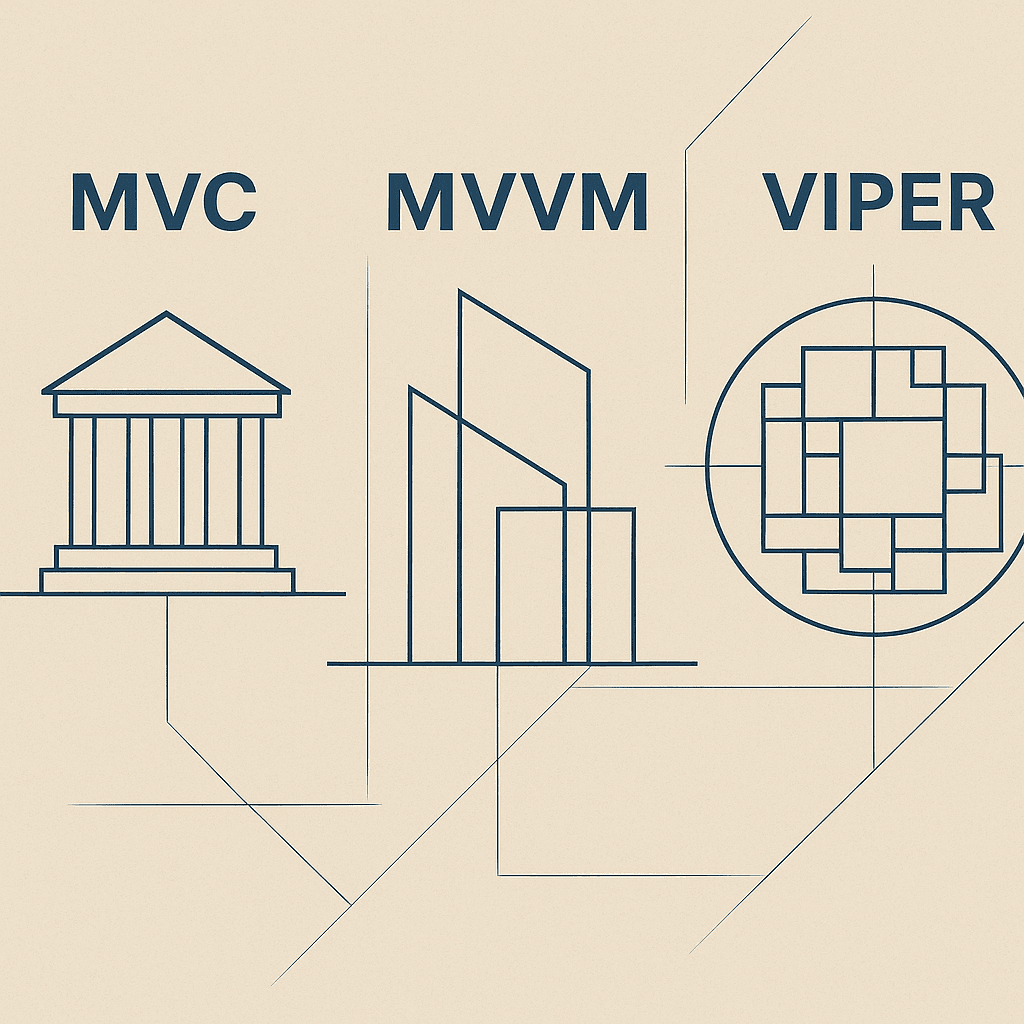

👷 Introduction: The Great iOS Architecture Dilemma
So, you’re starting a new iOS project. Exciting! 🎉 But before you even write import UIKit, there it is — The Big Question:
Should you go with MVC, MVVM, or VIPER?
If you’ve been in the iOS world long enough, you’ve probably heard some version of:
- “MVC? Oh, you mean Massive View Controller?”
- “MVVM is clean, bro… it’s the future!”
- “VIPER is scalable — and confusing — but scalable!”
Let’s face it: choosing an architecture feels a bit like picking a starter Pokémon 🐢🔥🌱 — each has strengths, weaknesses, and some wild evolution paths.
In this quick guide, we’re going to break down each architecture, compare their pros and cons, and help you figure out which one actually fits your app (and your sanity) in 2025.
🧾 Quick Comparison: MVC vs MVVM vs VIPER
MVC (Model-View-Controller)
✅ Simple to implement
⚠️ Often leads to “Massive View Controllers”
🔧 Great for small to mid-sized projects or MVPs
MVVM (Model-View-ViewModel)
✅ Better separation of concerns
⚠️ Can be tricky with data binding (especially in UIKit)
🔧 Ideal for medium to large apps, especially with SwiftUI
VIPER (View-Interactor-Presenter-Entity-Router)
✅ Super modular and testable
⚠️ Boilerplate overload 🤯
🔧 Best for large-scale apps with multiple teams
That gives readers a quick “choose-your-own-adventure” vibe.
Now, let’s go architecture by architecture. Here’s the next part: MVC Explained with Just Enough Sass 😄👇
🏗️ MVC: The OG of iOS
Ah, good old MVC — Apple’s favorite child (until it turned into a bit of a rebel).
In this pattern:
- Model handles the data (core logic, database stuff, etc.)
- View shows what’s on-screen
- Controller… does everything else. No, seriously. Everything. 🫠
That’s the catch — your controller ends up being the overworked employee who fetches data, prepares views, handles user actions, waters the office plants, and probably feeds your cat too.
Hence the nickname: Massive View Controller.
✅ When to use MVC:
- You’re building a quick prototype or an MVP.
- You’re working solo and don’t want too many moving parts.
- You enjoy life on the edge 😅
🔮 MVVM: Clean Code, Clear Conscience?
MVVM (Model–View–ViewModel) strutted into the iOS scene like,
“Hey, I heard your controllers were getting… chunky. Let me fix that.”
Here’s how it breaks down:
- Model is still your trusty data layer.
- View is your UI — calm and quiet, like a true SwiftUI monk.
- ViewModel acts like a translator between your data and the view. It prepares data, formats it, reacts to user interactions, and keeps the view chill and logic-free.
✨ Bonus: MVVM and SwiftUI are a match made in heaven 💘 because SwiftUI handles data binding so naturally, you barely notice how reactive your app is becoming.
⚠️ But wait — if you’re working with UIKit, MVVM can sometimes feel like overkill or just plain awkward, especially if you’re DIY-ing the bindings.
✅ When to use MVVM:
- Your app has multiple screens and dynamic data.
- You want better testability without full VIPER bureaucracy.
- You’re living the SwiftUI life 🍃
🐍 VIPER: Clean, Modular… and a Bit Extra
VIPER stands for:
View, Interactor, Presenter, Entity, Router — yep, it’s a full-on tech startup in itself.
This architecture is the most formal and strictly separated of them all. Each component has a single responsibility, which is great… until you realize you’re five files deep just to display a user profile 🫠
Let’s unpack it:
- View: Displays UI and user interactions.
- Interactor: Handles business logic (like fetching data).
- Presenter: Prepares data for the view and receives events from it.
- Entity: The data models (usually plain structs or classes).
- Router: Handles navigation logic between screens.
That’s a lot of folders… but it scales like a beast 💪
Each module is testable, isolated, and teamwork-friendly — a VIPER module is like a mini app in itself.
✅ When to use VIPER:
- You’re building a large, enterprise-level app.
- Your team has multiple developers working on separate modules.
- You love architecture so much, you dream in UML diagrams 🛌🧱
⚠️ When NOT to use VIPER:
- If your app has 3 screens and a single developer.
- If you value your weekends. 🏖️
🧭 Final Verdict: Which Architecture Should
You Choose?
Let’s keep it real — there’s no one-size-fits-all answer. Each architecture has its moment to shine ✨
So here’s a quick TL;DR:
👶 Go with MVC if
- You’re building a small app or MVP.
- You’re solo dev-ing and don’t want complexity.
- You’re okay with some logic living in the ViewController.
🧘♂️ Go with MVVM if
- You’re using SwiftUI (they’re besties).
- You want better separation and cleaner testable code.
- You’re cool with setting up data bindings manually (in UIKit).
🏗️ Go with VIPER if
- You’re building a big app, or working with a large team.
- You need modularity and testability at scale.
- You’re okay managing more files than a government department.
📦 Bonus Thought:
You don’t have to stick strictly to one. Some devs blend MVVM with Coordinator, or use Clean Architecture inspired by VIPER — and that’s totally fine.
Architecture is just a tool. Choose what helps you ship better, cleaner, and saner.
🎉 Enjoyed this article? Your support means the world to me!
💬 Drop a comment below! I love hearing about your experiences and answering questions
🎬 Subscribe on Youtube and become early subscribers of my channel: https://www.youtube.com/@swift-pal
💼 Let’s connect on LinkedIn for more professional insights: https://www.linkedin.com/in/karan-pal
Happy coding! 🚀
New articles, straight to your inbox.
No spam, no filler — just new writing on iOS, the web, and AI when it ships. Unsubscribe anytime.
Keep reading
Your CPU Has More Cores Than Your Job Can Use
Some work splits cleanly across hundreds of cores. Other work is a chain of steps where every new step has to wait for the last one to finish.
ReadYour Password Isn’t as Random as You Think
Crack-time calculators measure the size of a theoretical password space—not how people actually choose passwords or how attackers search them.
Read