Why Is ChatGPT Losing Money If Everyone Pays?
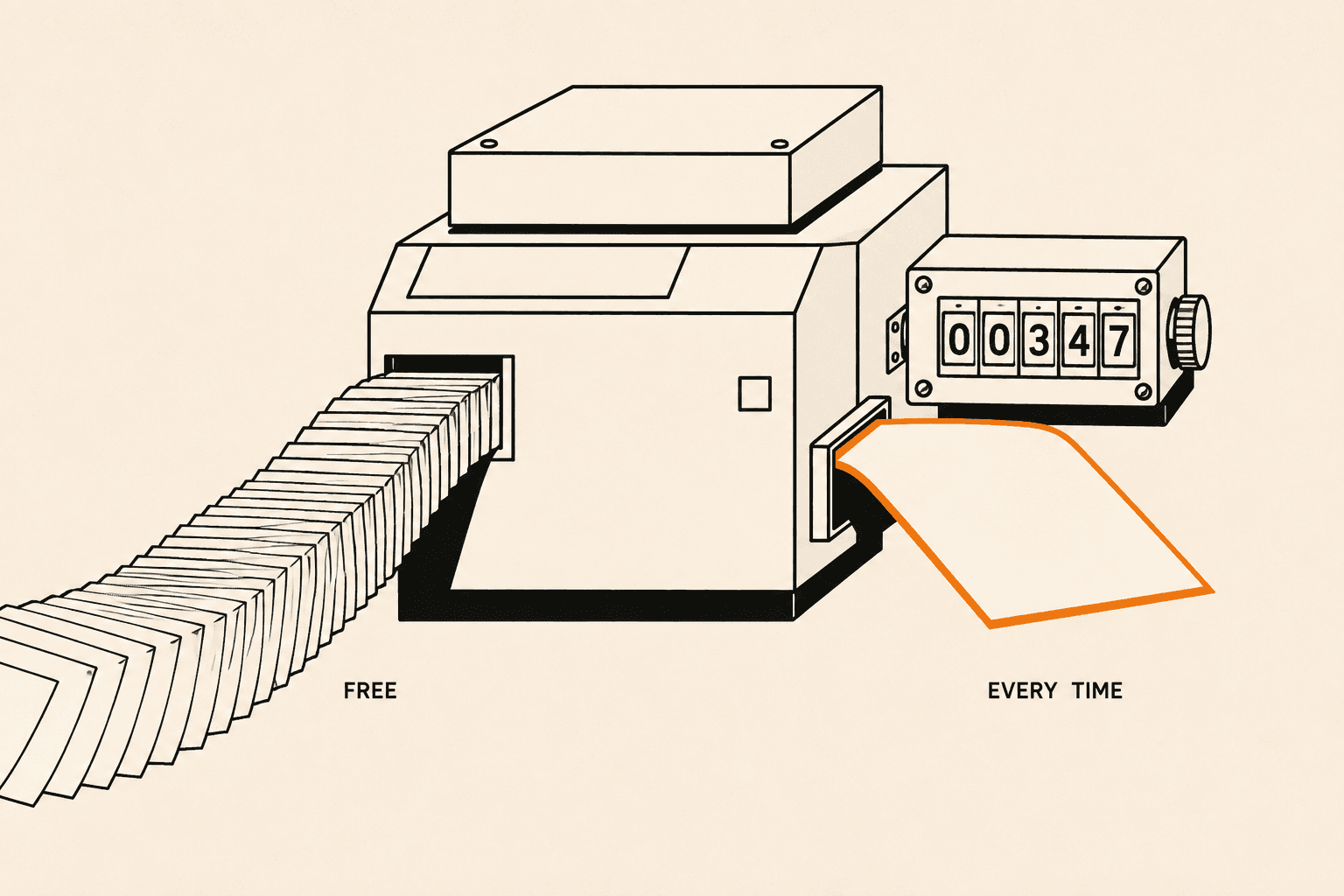
Every software business ever built rested on one property: the second copy is free. AI is the first product sold at scale where that stopped being true, and it is why the price per token keeps falling while the bills keep climbing.
You pay for ChatGPT every month. It shows up, it works, and nothing about that arrangement feels like it is in trouble. The company selling it to you is losing money on the deal anyway, and not by a little.
Microsoft owns a piece of the company behind ChatGPT, and because Microsoft is publicly traded it has to report what that piece is doing to its own accounts. So we get to look. Their FY26 Q1 filing puts it plainly: net income and diluted earnings per share were reduced by 3.1 billion dollars and 41 cents respectively, from losses on their investment in OpenAI. One quarter. Microsoft's share of the losses alone, not the whole thing.
Spread across ninety days that is roughly thirty-four million dollars a day.
You can see the same pressure from the other side, on your own account page. Somewhere in the last year the plan you pay for quietly changed shape: it used to say unlimited, then it said fair use applies, and now there is a number in the corner that goes down as you work. That happened across the whole shelf inside about twelve months, and not because a product manager somewhere got greedy.
The explanation people reach for is that the technology is young and expensive and will get cheaper. It did get cheaper. It has been getting cheaper for years, steeply, by any measure you like, and the losses got bigger anyway. That is the part that does not fit, and it is worth more than a shrug.
The one sentence answer
Every software business ever built rests on a single quiet assumption: the second copy is free. AI is the first product sold at scale where that stopped being true.
That is the whole thing. Everything below is why it matters so much, because the consequences run further than they look.
Why software was such an extraordinary business
Go back to ordinary software for a moment, because most people have never been told why it made so much money.
Somebody writes a program. That part is genuinely expensive. It takes years, it takes a building full of people, and it can fail completely, which is a risk somebody has to carry. But then it is finished, and something remarkable happens: you can hand it to a second person for nothing. And a third. And a millionth.
The copies cost nothing to produce, so the cost of serving one more customer sits on the floor at roughly zero no matter how many turn up.
That number has a name, and it is worth knowing because everything else here hangs off it. It is called marginal cost, and it means exactly one thing: what does it cost you to serve one more person? Not what it cost to build the product, not what your office costs, just the extra you pay because one more customer showed up today. For every software product before this one, the honest answer was almost nothing. A few pennies of bandwidth, and even that mostly went away.
That is why software could be sold flat. One price a month, use it as much as you like, and nobody selling it ever had to think about the customer who used it a thousand times, because that customer cost them nothing extra. The heavy user was free advertising. You wanted them.
Hold onto that, because the rest of this article is what happens when it stops being true.
What an AI answer actually costs
Now the other kind of product, and I am going to build this up from nothing rather than assume you have read anything else.
An AI model is a file. That is genuinely all it is, one file sitting on a disk, and inside that file a very long list of plain ordinary numbers. Those numbers are called weights, and there are billions of them. Each one is a setting that got nudged into position during training, which is the enormously expensive process of showing the thing vast amounts of text and adjusting every number a fraction at a time until its output stops being nonsense.
There is no text in that file. No sentences, no pages, nothing you could go and look up. It is numbers.
So how do you get a sentence out of a pile of numbers? You take everything written so far, your question plus whatever the model has already said, and you push it through those numbers. All of them, front to back. What falls out the other end is one word.
Not the answer. One word of it.
Then it does the whole thing again for the word after that. And again. Once per word, all the way to the end of the reply. Each of those pieces is called a token, which is the unit these systems actually count and bill in. A token is roughly a word or a chunk of one, so "understanding" might be two or three tokens while "the" is one. When you see a price quoted per million tokens, that is what is being counted.
Now put that next to the copies from a minute ago, because this is the whole argument in one comparison.
Nothing here is a copy. Your answer was not sitting somewhere finished, waiting to be handed to you. It got manufactured, for you, while you sat there watching it appear, and the person next to you asking the identical question got their own built from scratch. No part of the work is shared between the two of you.
Which means the cost line, the one lying flat on the floor for fifty years of software, does not lie flat any more.
It goes up. Every single time anybody uses the thing.
But why can't they just save the answer?
This is the obvious objection and it deserves a real answer rather than being skipped, because it is the thing that would fix everything if it worked.
They do, a bit. If two people send byte-for-byte identical text, some providers can reuse part of the work, and there is a genuine discount for it on most price lists. But it only helps at the very start of a request, and it needs the beginning of your text to match somebody else's exactly.
Almost nothing matches. Your question arrives attached to your conversation so far, your documents, your code, your instructions about how to answer. Two people asking the same thing in different words are, as far as the model is concerned, two completely different inputs. And the model writes its reply one word at a time based on every word it has already written, so even a shared opening diverges immediately and never converges again.
A search index works because everybody's query lands on the same pre-built structure. There is no pre-built structure here. The reply is the work, and the work is done fresh, which is the same sentence as before wearing different clothes.
A flat price is now a bet
This is where the pricing pages come in, and it is worth being precise about what changed, because the change is smaller and stranger than it looks.
The price is fixed. What you cost them is not. That was always technically true, but it never mattered, because what you cost them was approximately nothing and stayed there. Now the two numbers move independently, and one of them has no ceiling.
Most people barely touch these things. A few questions a week, some help with an email, and they are gone. Then there is the far end of the distribution, and it is much further out than it used to be.
A gym survives exactly this arrangement. The people who never go pay for the people who do, and it works because even the keenest member has to sleep, has a job, and can only physically be in the building so many hours. The ceiling is a real thing made of hours in a day.
That is not the shape of the heavy user any more. The heavy user is now a piece of software that uses the model on its own, in a loop, with nobody typing anything.
Those are called agents, and the word is doing real work so it is worth defining properly. An agent is a program that calls the model, reads the reply, decides what to do next, and calls it again, repeating until some goal is met. A coding agent asked to fix a bug might read forty files, form a theory, test it, discover it was wrong and start over. That is one instruction from you and several hundred model calls underneath it, most of which you never see.
An agent does not sleep. It asks a hundred times where you asked once, overnight, while nobody is watching. The gym analogy breaks here and it is worth saying so out loud rather than leaving it standing: there is no equivalent of running out of hours in the day, because the thing consuming the service is not a person with a day.
The part that is genuinely strange
So far this is just expensive. Here is the bit that surprised me.
The price of one unit of this stuff has been falling hard for two years, and the bills have been going up the whole time. Both of those are true, and they are true for the same reason.
When something gets cheaper you do not buy the same amount of it and pocket the difference. You buy far more of it. And so does everybody building products on top of it, which is the half that compounds.
There is real measurement on this rather than vibes. OpenRouter and a16z published a study of over a hundred trillion tokens of actual usage across thirteen months ending in November 2025, which is the largest public dataset on how these things are really used. Two of its findings do all the work here.
The questions people send got roughly four times longer, from about fifteen hundred tokens on average to over six thousand. Six thousand tokens is somewhere around four and a half thousand words, so call it fifteen pages of text going into the model with every request, where a year earlier it was about four.
The answers nearly tripled too, from about a hundred and fifty tokens to four hundred. A paragraph became a page.
And the models themselves changed. The ones that work a problem through before answering write all of that working out as words, one at a time, each costing a full pass through the file exactly like a visible word does. Most of it is never shown to you. OpenAI's own documentation is explicit that those hidden reasoning tokens are billed at the output rate, and a request can generate several times more of them than the answer it returns.
In that same study, models that work this way went from almost none of the traffic at the start of 2025 to more than half of it by the end.
Put those together and the paradox stops being a paradox. Cheaper per unit, far more units, and the second one has been winning comfortably. The cost per token is not what determines your bill. The number of tokens is, and it is the number that has been growing.
Two things I simplified
I have been telling this one way round, and I owe you two corrections before the end.
The first is that the falling price is not a story anybody made up to look busy. It is real and it is dramatic. Google measured the energy behind one of its own median text prompts and found it fell thirty-three times in a single year. That is extraordinary engineering, and it is happening across the industry.
The second is about the money spent building these models in the first place, which is enormous, and which I have deliberately kept out of the argument. That is not an oversight. Training a frontier model costs a fortune, but it is the ordinary kind of expensive: a big cost at the front that gets spread over every customer who comes after. Every business in history has had one of those, and the accounting for it is a solved problem. Building a factory is expensive too.
The genuinely new thing is not the cost at the front. It is the cost that turns up again with every single use and never goes away, because there is no copy to hand out. That is the sentence from the top of this article, arriving for the third time, and it is the only mechanism in the piece.
Nobody rewrites their pricing page for fun
You do not have to take my word for any of this, because the industry is currently telling you in public.
In April, GitHub announced that from the first of June its coding assistant would stop counting requests and start counting tokens, with a credit balance that draws down as you use it. Their stated reason is worth quoting rather than paraphrasing, because it is the entire argument of this article in a sentence written by somebody selling the product:
Today, a quick chat question and a multi-hour autonomous coding session can cost the user the same amount... the current premium request model is no longer sustainable.
That is from GitHub Copilot is moving to usage-based billing, published on the GitHub blog on 27 April 2026.
Notice what did not change. The monthly price stayed exactly where it was. What changed is that using it now costs something visible.
Nobody rebuilds how they charge for their product to dodge a problem that is not real.
The whole thing in three sentences
Every software product before this one cost nothing to serve to one more person, which is why it could be sold flat. An AI answer gets made from scratch every time, so it costs again, every time, and there is no copy to spread that cost across. So the thing you are buying is quietly turning from a subscription into a meter, and the falling price per token is not going to stop it, because your usage is growing faster than the price is falling.
The part I cannot measure from here is what that looks like on your side of it. So one specific question, and it costs nothing to answer: if you have hit a limit or a credit balance on one of these, what were you actually doing when you hit it? The public data says agents are the thing driving consumption, but that data comes from a developer API platform, which is exactly where you would expect agents to dominate. Whether it looks the same for people working in a chat window is a genuinely open question, and a few dozen answers would tell me more than another study would.
🎉 Enjoyed this article? Your support means the world to me!
🎬 Subscribe on YouTube for video versions of these posts: https://www.youtube.com/@swift-pal
💼 Let's connect on LinkedIn for more professional insights: https://www.linkedin.com/in/karan-pal
☕ If this saved you some time, you can buy me a coffee: https://coff.ee/karanpaledx
New articles, straight to your inbox.
No spam, no filler — just new writing on iOS, the web, and AI when it ships. Unsubscribe anytime.
Keep reading
Your CPU Has More Cores Than Your Job Can Use
Some work splits cleanly across hundreds of cores. Other work is a chain of steps where every new step has to wait for the last one to finish.
ReadYour Password Isn’t as Random as You Think
Crack-time calculators measure the size of a theoretical password space—not how people actually choose passwords or how attackers search them.
Read