Why Demo Trading Success Doesn’t Translate to Real Money Profits
🧪 Demo Trading Feels Easy Because There’s Nothing Real on the Line Learn why demo accounts boost your confidence — but not your emotional…
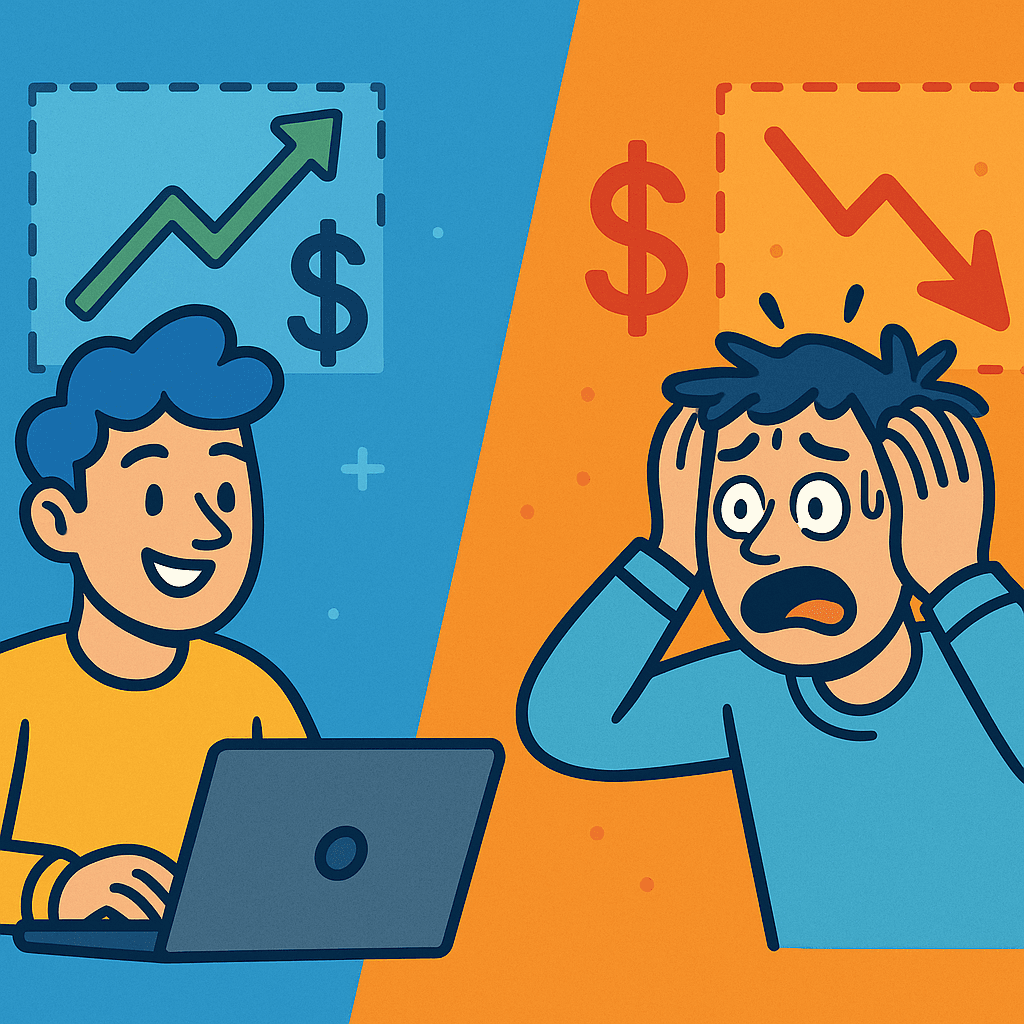

Note: This article includes an affiliate link to a trading tool I personally use and recommend. If you decide to use it, I may earn a small commission at no extra cost to you.
🤖 “Trading in God Mode” — What Demo Actually Gives You
Ah, demo trading. The magical playground where you’re a forex genius, your strategy never fails, and your account grows faster than a meme coin in 2021 🚀.
Demo accounts are incredible for learning the basics — placing trades, testing strategies, and understanding how the platform works. But let’s be real: demo trading is like playing poker with Monopoly money. Sure, you’ll make bold moves, go all-in, and maybe even feel like you cracked the code… but none of it actually hurts when it goes wrong.
Here’s what demo accounts give you that real ones don’t:
- No Emotional Risk 😌
- You’re not attached to the outcome because there’s no real money involved. You can lose a $10,000 demo trade and still sleep like a baby. Try that with your rent money.
- Unlimited Resets = God Complex 🤖
- Made a bad trade? Just restart. Got over-leveraged? No problem. Demo accounts often encourage reckless behavior masked as “testing.”
- Execution Confidence Without Fear ⛷️
- You pull the trigger on trades without overthinking. No hesitation. No stress. You become the version of yourself that only exists in theory.
But this “God mode” comes at a price — because once you switch to a real account, all those superpowers mysteriously vanish… and we’ll talk about that in the next part 👀
😰 Reality Check: Real Money Brings Real Fear
So you dominated demo trading and felt like the next market wizard… until you switched to a real account and suddenly forgot how to click “Buy” 😵💫
Welcome to the emotional rollercoaster of real money trading.
Here’s the harsh truth: the moment actual dollars are on the line, everything changes. Not because the charts are different (they’re not), but because you are.
Let’s break down how real trading flips your mindset:
- Fear Kicks In Like a Freight Train 🛤️
- Now, every pip feels personal. Even a minor fluctuation has you refreshing your PnL like it’s Instagram.
- You start to hesitate on Good Setups 😬
- That perfect A+ setup you’d take instantly on demo? Suddenly, you’re second-guessing, adjusting stop-loss, resizing… and missing the entry entirely.
- You Let Losers Run and Cut Winners Early 😩
- Because your brain screams, “Just close in profit! Don’t let it go red!” — which, ironically, is how small wins and big losses are born.
- Greed Joins the Party Too 🤑
- Made a little profit? Great, now you want more. Let’s double down! Let’s trade NFP with no stop-loss! (Don’t do that.)
Demo doesn’t prepare you for this mental war. Real money makes even the calmest trader sweat bullets. And it’s not your fault — it’s just biology + psychology + capitalism doing their thing 😂
Ready to unpack how your brain actually gets hijacked during real trades? Let’s hit that next 🧠💥
🧠 Why Your Brain Behaves Differently With Real Stakes
You might think you’re the same trader on a real account as you were on demo. Same strategy, same chart, same time frame. But once your actual money is involved, your brain’s like:
“Nice strategy, but imma panic now.” 😵🔥
Here’s what’s really going on behind the scenes of your forehead:
🧪 1. Your Brain Enters Survival Mode
When money is at risk, your brain treats it like a threat to survival. You’re not just losing pips — you’re losing food, rent, respect, dreams, your imaginary Lambo 🐍. This activates your amygdala, the part responsible for fight-or-flight responses.
So what happens?
- You freeze on entries.
- You close trades too early.
- You randomly move stop-losses and feel proud of it… until the loss is bigger.
⚡️ 2. Hormones Start Trading For You
Your calm, logical thinking? Hijacked by adrenaline and cortisol, a.k.a. the “chaos chemicals.” They make you:
- Overtrade
- Second-guess setups
- Take revenge trades out of frustration
At this point, it’s not you trading anymore. It’s your inner caveman in panic mode with a trading app 🪓📱
💭 3. Overconfidence Turns Into Self-Doubt
You were fearless on the demo. But now every red candle feels like a personal attack. You stop trusting your strategy, and worse, you start tweaking it mid-trade, which is like switching seats in a rollercoaster mid-loop 🎢 (bad idea).
The irony?
The market didn’t change. You did. And the only way out is understanding and taming this mental madness. (Don’t worry — we’ve got a section for that too 😉)
💣 Common Mistakes Traders Make During the Transition
Switching from demo to real isn’t just a change in account type—it’s a rite of passage. And like most rites of passage, it usually comes with a good ol’ reality smack in the face 👋
Here are the biggest traps traders fall into when making the leap:
🧨 1. Overleveraging to Prove You’re Still a “Demo God”
You crushed it on demo, so you think, “Let me just double this $100 real account in a week to confirm my greatness.”
Spoiler alert: margin calls don’t care about your demo win streak 😬
🧱 2. Using the Same Lot Sizes from Demo
In the demo, you probably traded standard lots like a baller 💅. But in real life? That same lot size on a $200 account turns every pip into a heart attack. Adjust your risk—or prepare to become a case study in emotional breakdowns.
🤡 3. Expecting the Same Smooth Ride
You think real trading will feel just like a demo. It won’t. There’s latency. There’s slippage. There’s that weird pressure of watching real cash disappear faster than your weekend savings. You need to relearn how to breathe in the live market.
🔁 4. Chasing Losses Immediately
Took a real loss? The instinct is to “get it back.” And suddenly you’re:
- Overtrading
- Taking random setups
- Trading pairs you’ve never even looked at before (Hello, exotic currencies 👀)
And poof—there goes your account faster than a Tinder match who saw your PnL.
🙅 5. Ignoring Emotions Because “I’m Logical”
LOL. No, you’re not. Not when real money is involved. Thinking emotions won’t affect your trades is like saying horror movies won’t scare you if you keep the lights on.
💥 Truth bomb: These mistakes are part of the journey, but you don’t have to repeat them like a rite of failure. In the next section, we’ll look at how to bridge that gap with actual strategy and self-awareness.
🧘♂️ Bridging the Gap: How to Make the Shift Smooth
Okay, so your demo confidence got demolished by real market emotions. It happens to literally everyone. The good news? You don’t have to stay stuck in that psychological blender 🌀
Here’s how to make the transition from demo wizard to real-world trader a lot smoother (and less painful for your bank account):
🐢 1. Start Small. Like, Really Small.
Don’t rush in with big lot sizes just to “test the waters.” That’s not testing — it’s drowning. Start with micro lots. The goal is emotional calibration, not profit domination.
📔 2. Journal Everything — Especially Emotions
Track not just trades, but how you felt during them. Fear, greed, confidence, hesitation. Over time, you’ll start spotting emotional patterns just like you do price action patterns.
(Spoiler: You overtrade when you’re bored. Admit it. 😏)
🔁 3. Re-Trade Your Best Demo Setups… With Real Stakes
Pull your old demo trades and replay them with small real capital. If it were a textbook setup on demo, it should still work — unless fear interrupts the flow. This is how you train your brain to trust your plan under pressure.
💼 4. Use Prop Firm Challenges as a Bridge
This is where a tool like The 5ers comes in clutch 💸
Want to feel real-money pressure without blowing up your own account?
_Prop firm accounts_ (like _The 5ers_) let you trade real capital, stick to risk rules, and build discipline — without putting your own life savings on the line.
It’s like a dress rehearsal for real trading, but with actual rewards.
(If you’re curious, here’s my affiliate link — use it only if you’re ready to treat trading like a real business, not a weekend casino. 🎰)
**We Fund the Top 5% Traders | Most Profitable Forex Funding Prop Firm** _Meet The5ers Proprietary Trading Fund, the Best-Funded Trading Program for Forex Traders. The5ers is a forex prop firm…_www.the5ers.comhttp://www.the5ers.com?afmc=sla
🧘♀️ 5. Accept Losses as Tuition
You will lose. Not every trade will win. But if you treat losses like feedback instead of failure, you’ll progress faster than 90% of retail traders still rage-trading after a red candle.
Making the switch from demo to real trading isn’t just about strategies — it’s about emotional maturity. And like with any growth… You gotta get a little uncomfortable first 😮💨
👋 Final Thoughts: You’re Not Broken, Just Human
If you’ve ever wondered,
“Why am I suddenly trash at trading now that real money is involved?”
You’re not alone—and you’re definitely not broken.
You’re just human. And humans + money = chaos 💥🧠
Trading isn’t just about patterns and pips—it’s about navigating your own psychology when the stakes are real. The demo account gave you skills. But the real account? That’s where you build character (and scars 💀).
Some last reminders for the road:
- Everyone fumbles the switch from demo to real. It’s practically a rite of passage.
- Your strategy isn’t the problem—your emotional reactions probably are.
- Tools like funded accounts (like The 5ers) can be a stepping stone while you level up emotionally.
- Your trading edge is only as sharp as your discipline.
So next time a real-money trade has you sweating like a crypto bro in a bear market 🐻📉—just breathe. You’re learning. You’re growing. And most importantly?
You’re not alone.
👇 Now your turn
New articles, straight to your inbox.
No spam, no filler — just new writing on iOS, the web, and AI when it ships. Unsubscribe anytime.
Keep reading
Your CPU Has More Cores Than Your Job Can Use
Some work splits cleanly across hundreds of cores. Other work is a chain of steps where every new step has to wait for the last one to finish.
ReadYour Password Isn’t as Random as You Think
Crack-time calculators measure the size of a theoretical password space—not how people actually choose passwords or how attackers search them.
Read