What Happens to Your Internet When an Undersea Cable Is Cut?
Three cables were cut in the Red Sea in 2024 and the traffic graphs did not move. Here is why that happened, and the two places where it stops being true.
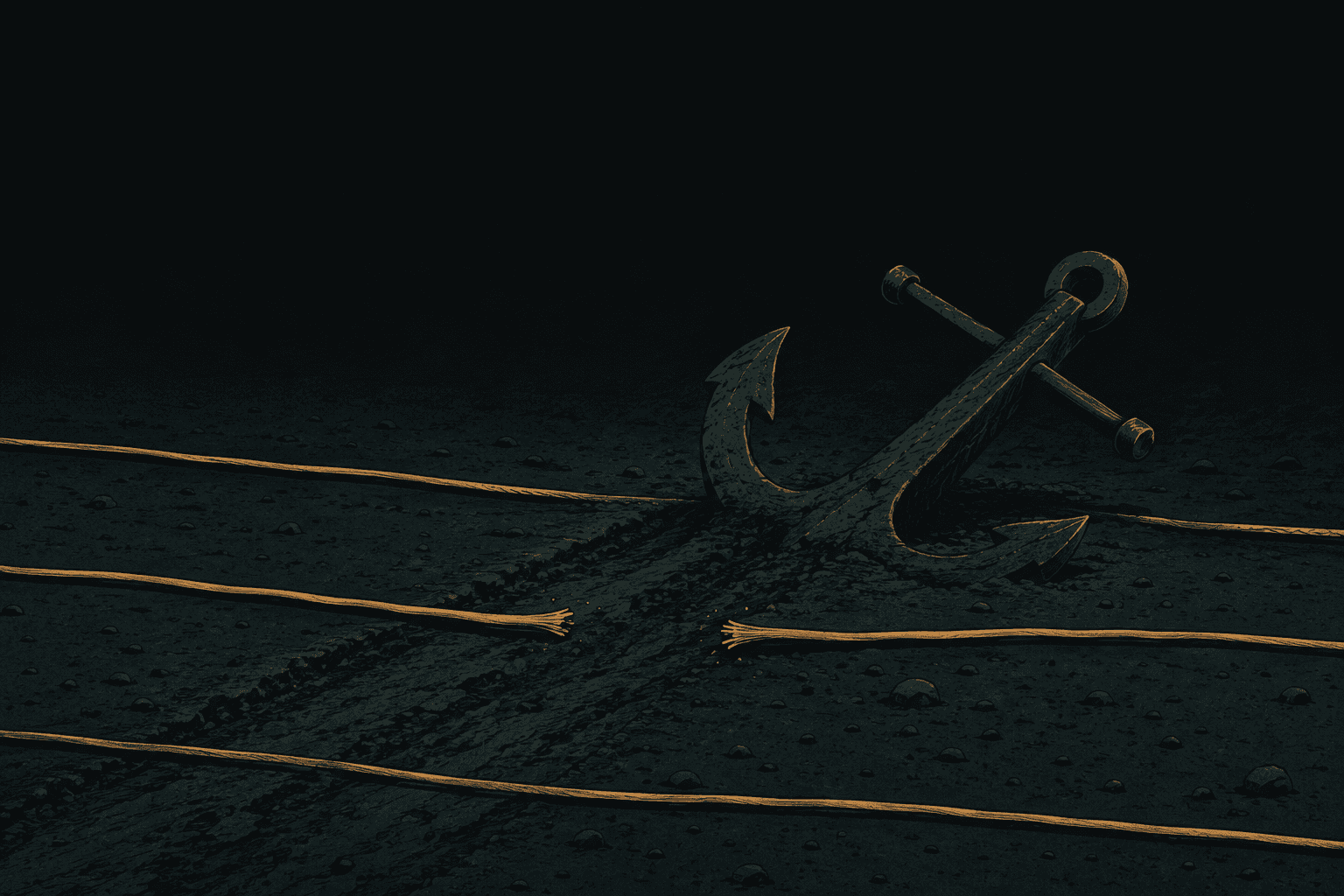
In February 2024 a cargo ship called the Rubymar was hit by a missile in the Red Sea. The crew got off. The ship did not sink straight away, and for several days it drifted through the shipping lane with its anchor down, dragging along the seabed beneath it.
Somewhere under that ship were three cables carrying internet traffic between Europe, Asia and Africa. The anchor probably cut all three. American officials said “probably”. That word has never been upgraded, so it stays here too.
Cloudflare sits in front of a very large share of the world's web traffic. That puts them in an unusually good position to notice when a chunk of the planet loses its connection, and they went and looked at every country the cut should have affected.
They found nothing. No loss of traffic anywhere.
That is easy to read past, so I want to be precise. Their measurements show the outage did not appear in the traffic graphs at all, in any affected country, for a cut that severed three cables in one of the busiest shipping corridors on earth. Not a dip that recovered. Nothing.
That is the thing worth understanding, and the explanation turns out to be one idea repeated four times.
This happens far more often than you think
Cables break constantly. TeleGeography, who map the things for a living, put it at two to four breaks somewhere in the world every week, and the International Cable Protection Committee counts roughly two hundred faults a year, a figure that has held steady for about a decade.
Those two numbers come from different organisations counting separately. Two hundred a year works out at 3.8 a week, which lands inside “two to four”. Independent counts agreeing that closely are usually worth trusting.
Two hundred a year is one every other day. Every other day. You have never noticed a single one.
The causes are less exotic than the Rubymar suggests. Across fifteen years of fault data, fishing gear and ships' anchors account for 86% of every recorded fault, which is six of every seven, and almost all of it happens in shallow water near a coast. Earthquakes and landslides are 7%. Abrasion, where a cable rubs itself raw against rock in a current, is 4%. Equipment simply failing is 3%. The rest is unlucky.
Sharks are not on the list. They were, briefly, in the eighties. The story has comfortably outlived the fact: between 2007 and 2014, across every fault anybody logged, fish bites caused zero.
What is actually down there
A submarine cable is smaller than most people picture. In deep water it is 17 to 25 millimetres across. That is about a garden hose. Near shore it gets much fatter, because that is where the trawlers and the anchors are, so it is wrapped in steel armour that can double or triple its diameter.
The armour is not the interesting part. It is packaging. At the centre of all that steel and plastic sits a handful of glass strands, each roughly the width of a human hair, and the whole point of the cable is to keep those strands intact. A single-mode optical fibre is about 125 micrometres across, cladding included. A human hair runs somewhere around 70 to 100. Same order of magnitude. Near enough that “the width of a hair” is honest rather than a flourish.
Your data crosses the ocean as light, bouncing along the inside of those strands and never leaving the glass. There are over 1.5 million kilometres of it down there. Very nearly four times the distance to the Moon.
It is also worth killing the assumption that there is a wireless backup sitting above all this. There isn't. FCC data puts satellites at 0.37% of all US international capacity, which works out at fewer than four bits in every thousand that cross an ocean, and the remaining nine hundred and ninety six travel through glass. Satellites matter enormously for ships, aircraft, remote research stations and places with no cable at all. They are not a spare tyre for the internet.
The reason nothing happened
Nothing you do reaches another continent over one cable.
TeleGeography track more than 600 active and planned submarine cables. The Red Sea corridor the Rubymar was drifting through carries a lot of them. It is the only sensible way from Asia to Europe without going round Africa, so the cables crowd into it. Cutting three is a serious event for the companies who own them, and an expensive one to repair. It is not an outage. It never removed your only path, because you never had one. It removed three of many. That is a different thing entirely.
The redundancy is deliberate rather than lucky. TeleGeography describe the industry practice plainly: companies spread their capacity “across multiple cables so that if one breaks, their network will continue to run smoothly over the other cables while service is restored on the damaged one”.
Read that again with the money in mind. Your provider is paying for capacity it is not using, on cables it does not need today, in case something happens to the cable it is using. You are paying for that. It is on your bill, you have never noticed, and that is more or less the definition of infrastructure working.
 Watch on YouTubeHow Is Your Internet Connected to an Undersea Cable?The same story as a video, tracing one cable from a beach in Mumbai to the south of France.
Nobody decides to switch
The part that surprised me most is that no human is involved. Nobody watches a dashboard, spots the break and presses something. Nobody is paged. It happens in two separate places, one after the other, and both of them are automatic.
The first is the optical layer. That means the equipment sitting at each end of the cable, the machines that turn your data into pulses of light at one end and turn it back into data at the other. They listen for that light constantly. When it stops arriving, that is the entire detection step. There is nothing to diagnose and nothing to work out. Light was arriving. Now it isn't.
What happens next has a name. It is called protection switching, and it is worth knowing, because it is the reason you never feel any of this. The equipment is already holding a second path open, configured in advance, paid for, carrying nothing at all. When the light stops, the traffic moves onto it. That is the whole mechanism.
The standards that gear is built to are specific about how fast. ITU-T G.841 set it at under 50 milliseconds, with an objective of 25, and that requirement carried forward into the later standards for optical transport networks. A millisecond is a thousandth of a second. Fifty of them is a twentieth of one.
Published figures for a human blink run from 100 to 400 milliseconds. So the switch finishes in less than half the time of even the fastest blink anybody measures. A video call does not stutter. A download does not pause. Nothing in your experience has a slot small enough for it to fit into.
The second place is the routers. That is the same kind of machine as the box in the corner of your room, scaled up enormously and repeated the whole way across the internet. Routers spend their entire working lives telling each other which destinations they can currently reach. When a link dies, the router advertising a path through it stops advertising it. Everything downstream hears that withdrawal and picks its next best route. The traffic moves in seconds.
There is a famous line about the internet interpreting censorship as damage and routing around it. It makes all of this sound like a property of the network, something emergent and slightly magical.
It isn't. Somebody bought a second path, in advance, and paid an engineer to configure the equipment to fail onto it. The machinery then uses it without asking anyone. What looks like emergent resilience is a purchase order.
A spare path is only spare if it has room
A second route is worthless if it is already full. That part usually gets skipped. There is a clean public measurement of it.
On 14 March 2024, four cables went down off West Africa at roughly the same time, reportedly to an underwater rock fall, which is exactly the kind of event a single spare route is supposed to survive. Operators pushed their traffic onto Google's Equiano cable, and Cloudflare recorded Equiano carrying four times its normal load. It absorbed that and kept running. Nobody outside the industry noticed.
Four times. Absorbed by one cable, without anyone having pre-arranged it for that particular disaster. The spare capacity sitting unused on the seabed on an ordinary Tuesday is not a rounding error.
Where this stops being true
Everything above depends on one condition, and when the condition fails the internet goes down exactly the way you would expect it to.
In January 2022 the Hunga Tonga eruption cut the single cable connecting Tonga to the rest of the world, and everything described above stopped being relevant in an instant. There was no protection switching, because there was nothing to switch to. There was no rerouting, because there was no second route. Tonga was offline for 38 days, five and a half weeks, while a repair ship travelled to the site and replaced a 92 kilometre section of an 827 kilometre cable.
Nothing about the technology failed there. The fifty millisecond switch is real. The routing works. Neither one can do a thing for a country with one cable, which gives us the sentence properly:
Resilience is not a property of a cable. It is a property of having more than one, and plenty of places do not.
The word for that is redundancy, having more than one of something so that losing one costs you nothing. It is one of the few pieces of jargon in this whole subject that is worth carrying around, because it applies far beyond cables.
The West African cuts are the same lesson wearing different clothes. Four cables went at once because cables are not spread evenly around the planet. They follow coastlines. They crowd through the same straits, the same shallow water, the same narrow corridors, because those are the routes that are physically possible and legally permitted to lay. Four separate cables can have four separate owners and still be close enough together that one rock fall takes all of them.
Thirteen countries felt that one. Some for hours. Some for days. Full repairs ran until the end of April, six and a half weeks of ships working one break at a time, because a repair means finding the fault, grappling the cable up off the seabed, cutting out the damaged section and splicing in new cable, in open water, in whatever weather there is.
So the same question answers all four incidents. How many alternatives were there, and did they have room? The Red Sea had many with room and produced no measurable outage. West Africa had alternatives that shared a corridor, so several went together and one cable absorbed four times its load while the rest recovered slowly. Tonga had none and went dark for over a month.
Somebody has to go and fix it
The switching buys time. It does not fix anything, and the fixing is where this stops being a story about clever engineering and starts being a story about ships.
A repair goes roughly like this. First the operator works out where the fault is, which they can do to within a kilometre or so by measuring how light reflects back from the break. Then a ship sails out. There are not many of them. That might be a day away. It might be a fortnight. The crew drops a grapnel over the side, drags it along the seabed until it snags the cable, and then winches one of the cut ends all the way up to the surface. In water three or four kilometres deep, that is slow work.
Then they buoy that end off, go back for the other one, haul it up, cut out the damaged section, and splice in fresh cable. A splice is done in a clean room on a rolling ship, aligning glass fibres to within a fraction of their own width. Then the whole repaired section goes back over the side.
The ICPC counted 206 repairs in 2023, spread across 136 different jurisdictions. Most of that work happens in somebody's territorial waters or exclusive economic zone rather than on the high seas, which means the ship needs a permit before it can start.
The permit is the part that bites. The longest single repair in that year's data took 947 days. Not because a splice is hard. Because of where the cable was, and who had to sign what before anybody was allowed to touch it.
There is a slower problem underneath all of this. The fleet that does the repairing is old. TeleGeography's analysis puts the investment needed at roughly $3 billion, covering 15 replacement ships and 5 additional ones, and estimates that around two thirds of cable maintenance ships will reach the end of their service life by 2040.
That is worth sitting with. The reason a cut in the Red Sea did not register in anyone's traffic graph is redundancy, and redundancy does not repair anything at all. It only buys time. The time gets spent by a shrinking number of ageing specialist ships, crewed by people whose job most of us have never heard of.
What this changes
Not much, and that is sort of the point. You cannot act on any of it. There is no setting to change and nothing to buy.
What it does replace is a bad mental model. Most people picture the internet as something in the air, with cables as a legacy detail. It is very nearly the opposite. It is glass on a seabed, tens of thousands of kilometres of it, cut by fishing boats about every other day, and held up by the fact that somebody bought more of it than they needed.
The next time a cable cut makes the news with the word “outage” attached to it, the useful question is not what broke or who owned it. It is how many alternatives that region had, and whether they had room.
If you have been somewhere during a real cable outage, I would like to know what it was actually like on the ground. Not the headline, the texture of it. What still worked, what didn't, and how long before it felt normal again. That is the one thing I cannot get from a fault database.
🎉 Enjoyed this article? Your support means the world to me!
🎬 Subscribe on YouTube for video versions of these posts: https://www.youtube.com/@swift-pal
💼 Let's connect on LinkedIn for more professional insights: https://www.linkedin.com/in/karan-pal
☕ If this saved you some time, you can buy me a coffee: https://coff.ee/karanpaledx
New articles, straight to your inbox.
No spam, no filler — just new writing on iOS, the web, and AI when it ships. Unsubscribe anytime.
Keep reading
Your CPU Has More Cores Than Your Job Can Use
Some work splits cleanly across hundreds of cores. Other work is a chain of steps where every new step has to wait for the last one to finish.
ReadYour Password Isn’t as Random as You Think
Crack-time calculators measure the size of a theoretical password space—not how people actually choose passwords or how attackers search them.
Read