How I Built My Own Forex Trading Bot (and Why I Trust It More Than Myself)
I couldn’t trust myself to follow my own trading rules… so I built a bot that could. Turns out, it’s better at staying calm than I am.
I couldn’t trust myself to follow my own trading rules… so I built a bot that could. Turns out, it’s better at staying calm than I am.

I didn’t set out to build a trading bot. I set out to become a consistently profitable Forex trader.
But after months of emotional chaos — missed entries, revenge trades, overtrading, undertrading, panic exits, confidence surges followed by deep regret — I had to face the uncomfortable truth:
I was the biggest threat to my own trading account. 😅
Every time I thought, “I’ll just manage this one manually,” it ended with me either overthinking a setup into oblivion… or entering at the worst possible time because “it just looked right.”
Eventually, it hit me. I’m a software engineer. I solve problems with code. So… what if I stopped trying to force myself to trade like a robot — and just built one?
What started as a fun experiment quickly turned into something I trust more than my own hands on the mouse. This is how I built my own Forex trading bot — why I made it, what it does, and how it ended up being the most emotionally stable member of my trading team. 🤖💼
🤯 Why I Needed a Bot (Let’s Be Honest)
At some point, I had to admit it:
I wasn’t losing trades because my strategy was bad… I was losing trades because _I_ was bad at following it. 😅
I’d overanalyze good setups until they were gone. I’d jump into half-baked trades just to “catch the move.” I’d randomly increase lot sizes after a win because I felt invincible. And of course, there were those beautiful moments when I got stopped out… and then re-entered immediately to “get it back.” Spoiler: Sometimes it worked… but most of the time, it just made things worse.
The strategy I followed was solid — it worked for others, and even helped me pass a prop firm challenge early on. But sticking to it? That was the hard part. I knew what to do, I just couldn’t do it consistently.
So I stopped trying to be the perfect trader… And I started thinking like a developer: “What if I could write code that follows the strategy better than I do?”
Enter: the bot. 🤖
🧠 The Idea: What If I Could Automate My Trading Brain?
At some point, I had this moment of clarity (or caffeine-fueled frustration, not sure which): “If I can follow a system in code… why can’t I follow it in real life?” Answer: Because I’m human. And humans panic, hesitate, overthink, and sometimes place random trades at 2AM for reasons unknown. 🤷♂️
So I thought — what if I could build something that didn’t flinch? No fear. No greed. No revenge trades. Just cold, calculated logic.
The goal wasn’t to create some magical profit-making machine. It was to build something that could do what I _already knew_ I was supposed to do… but failed to execute consistently.
I didn’t want to make it “smarter.” I wanted it to be boring.
- Follow the setup
- Respect the rules
- Manage the risk
- Walk away
A bot that didn’t care if it was right or wrong — it just did what it was told. Which, ironically, is way more than I can say for myself during my first nine months of trading 😅
That’s when I knew: I didn’t need a better strategy… I just needed to get out of my own way.
🛠️ How I Actually Built It
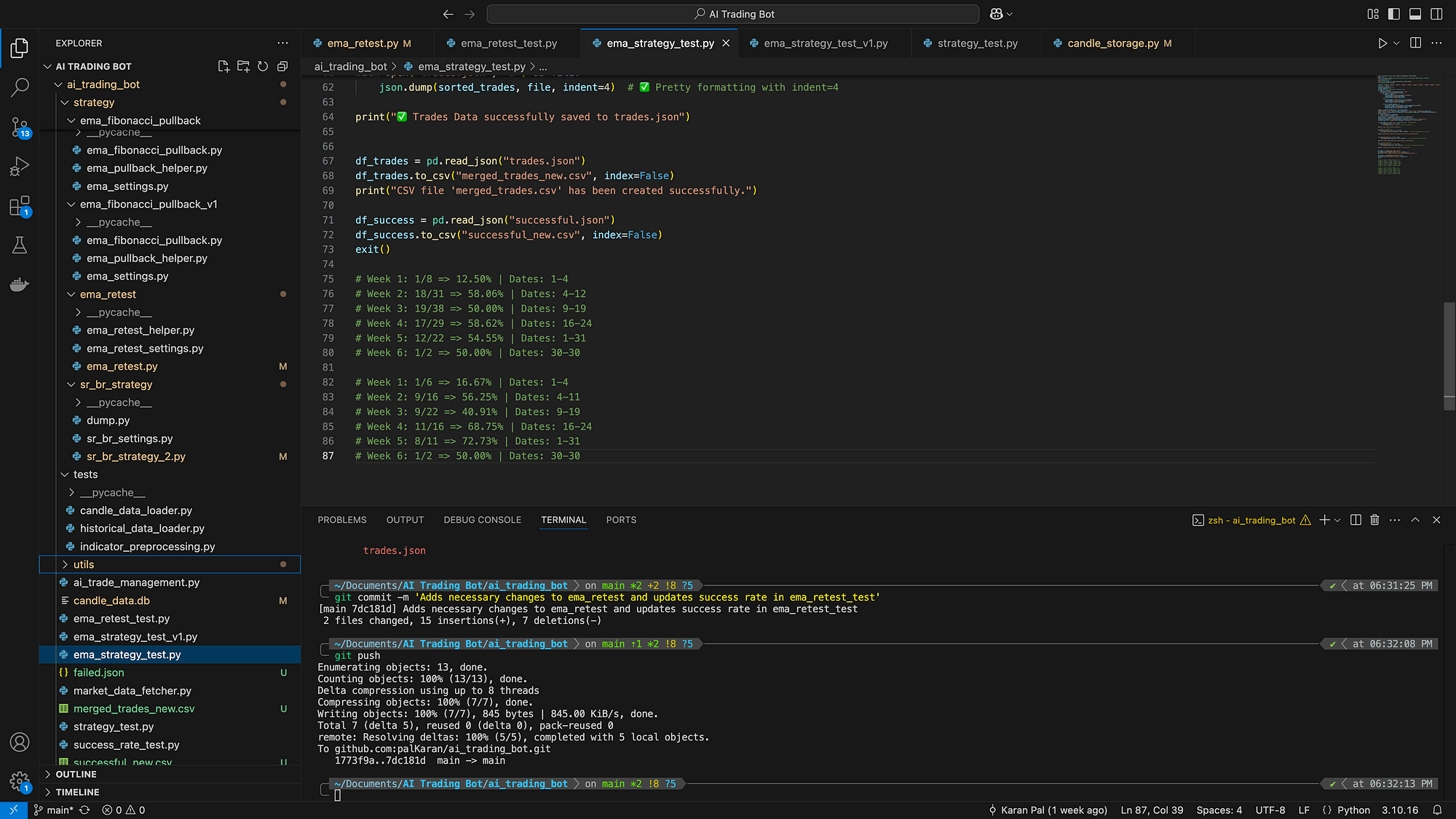
I’m an iOS engineer by profession — Swift is my comfort zone. But Python? Running 24/7 systems? Trading integrations?? Yeah… no clue. 🫠
That’s when I turned to ChatGPT. The plan was simple: ask the AI to help me build an AI-powered trading bot. What could possibly go wrong, right?
At first, it was magical. I was writing more Python in 2 days than I’d ever written in my life — copying, pasting, and feeling unstoppable. The files were stacking up, the code looked impressive, and I was like “Damn, I might actually pull this off.”
Then I tried to run it. Big mistake. Huge.
ChatGPT had helped me write all this code… but it didn’t remember how it fit together. I’d ask it about a function it created two days ago, and it’d respond like, “Hmm, interesting. Who wrote this?” The project structure was a mess. The flow made no sense. And I realized I had no idea how to connect the dots.
That moment hit hard. I stepped away from my desk and just… sat there. Frustrated. Burned out. Dreams of building the next-gen AI bot? Shattered. 💀
But after a long sit, a mild existential crisis, and a snack or two, I regrouped. Instead of letting a single ChatGPT thread spiral out of control, I got organized. I broke the project into modules — one thread for data handling, one for trade execution, one for strategy logic, and so on. Basically, I became the project manager for my AI assistant. Gave it structure. Gave it context. Controlled the chaos.
And just when I thought things were back on track, I hit another wall.
My original plan was to build a full-blown AI bot — one that could read market conditions, learn over time, and take smarter trades than I ever could. So I started training models using the database I’d built… And they failed. Like, completely. The results were worse than flipping a coin on a moving train. 🎲🚂
So I made a tough call: I shelved the AI. Instead, I used the same database to manually write strategies and backtest them. I kept refining the logic, adjusting entry/exit conditions, tweaking R:R ratios, and tightening up the codebase.
And after three intense weeks — filled with bugs, breakthroughs, and lots of debugging therapy — I had a working bot.
Not perfect. Not AI-powered. But consistent, logical, and most importantly — emotionally bulletproof.
🤖 Why I Trust It More Than Myself Now
Let me be clear: my bot isn’t a genius. It’s not doing quantum math, predicting NFP outcomes, or discovering the meaning of Fibonacci. But you know what it does really well?
It follows the rules.
It doesn’t:
- Chase trades because it’s feeling left out
- Skip entries because a mentor posted a conflicting setup on Telegram
- Move stop-losses around in the middle of a trade because it “just doesn’t feel right” today
It just executes. No fear. No overconfidence. No emotional baggage. It trades exactly how I always said I would — but never could. 😅
One of the first moments that really hit me was watching the bot enter a trade I would’ve 100% skipped. It looked too obvious. Too clean. I would’ve doubted it, second-guessed it, and missed it.
The bot? Entered. Managed risk. Hit Take Profit.
I was sitting there like, “So… this is what following a plan feels like.” 🫢
It still makes mistakes — because I do. The logic isn’t perfect. Some trades lose. But the discipline? The consistency? The ability to execute without spiraling into self-doubt?
That’s where the bot wins.
🧪 Is It Perfect? Nope.
Let’s not romanticize it — this isn’t some magical profit machine. It still takes losing trades. It still needs maintenance. And no, it hasn’t replaced me with a beachfront villa in Bali just yet. 🏝️
There are days when the market shifts in ways I didn’t account for. There are edge cases the bot doesn’t handle (yet). It doesn’t skip SLs, thankfully — I made sure of that. But sometimes, it ignores a really beautiful setup that I would’ve taken in a heartbeat. Other times, it enters trades I would never touch — the kind where I instantly know it’s doomed… and yep, it is. 😅
Plus, even though it’s emotionally stable, I’m still not. I have to fight the urge to interfere, override decisions, or turn it off when it’s in a drawdown — because hey, I still have trust issues.
But here’s the key difference:
The bot doesn’t deviate from the plan. It doesn’t care about how many wins or losses it’s had in a row. It doesn’t seek revenge or validation. It just does what it was told to do — every single time.
And that, alone, makes it a better trader than I was in my first nine months.
🎯 Final Thoughts
Building a trading bot wasn’t just about automation. It was about finally admitting that discipline > knowledge — and that sometimes, the smartest thing you can do as a trader is remove yourself from the equation. 🤷♂️
I didn’t build this bot to be perfect. I built it to be better than the version of me who second-guesses every trade and moves stop-losses out of sheer anxiety.
And honestly? It is.
In fact, here’s a perfect example: I recently took a manual trade — clean entry, solid setup (marked with the blue arrow in the screenshot below).

But instead of trusting my plan, I moved my stop-loss to breakeven way too early. What happened next? You already know. Price kissed my breakeven at red arrow, kicked me out of the trade, then took off toward my original Take Profit like nothing happened. 😩📈
This is exactly why I built the bot. It would’ve followed the plan. I didn’t.
If you’re struggling with consistency, getting wrecked by your own psychology, or just tired of saying “I knew it would go there!” after missing the move… maybe it’s time to stop forcing yourself to trade like a machine — and build a machine that trades like you’re supposed to. 🤖
It won’t be easy. You’ll probably break things along the way. But when it starts running… and you see your plan being followed… and it hits Take Profit on a trade you didn’t even know it entered…
You’ll get it.
That’s the moment it clicks.
If you’re working on something similar — or want a breakdown of how my bot works under the hood — feel free to reach out or drop a comment!
Spoiler: I blew some accounts, skipped some perfect setups, and made every possible emotional trading mistake. If you’re into trading pain and plot twists → \[_Read this_\]. 😅
New articles, straight to your inbox.
No spam, no filler — just new writing on iOS, the web, and AI when it ships. Unsubscribe anytime.
Keep reading
Your CPU Has More Cores Than Your Job Can Use
Some work splits cleanly across hundreds of cores. Other work is a chain of steps where every new step has to wait for the last one to finish.
ReadYour Password Isn’t as Random as You Think
Crack-time calculators measure the size of a theoretical password space—not how people actually choose passwords or how attackers search them.
Read