GCD vs Operations vs Swift Concurrency — Made Easy for iOS Engineers
Confused about when to use GCD, OperationQueue, or Swift Concurrency in your iOS projects? This guide breaks it down with clarity so you…

📝 Introduction:
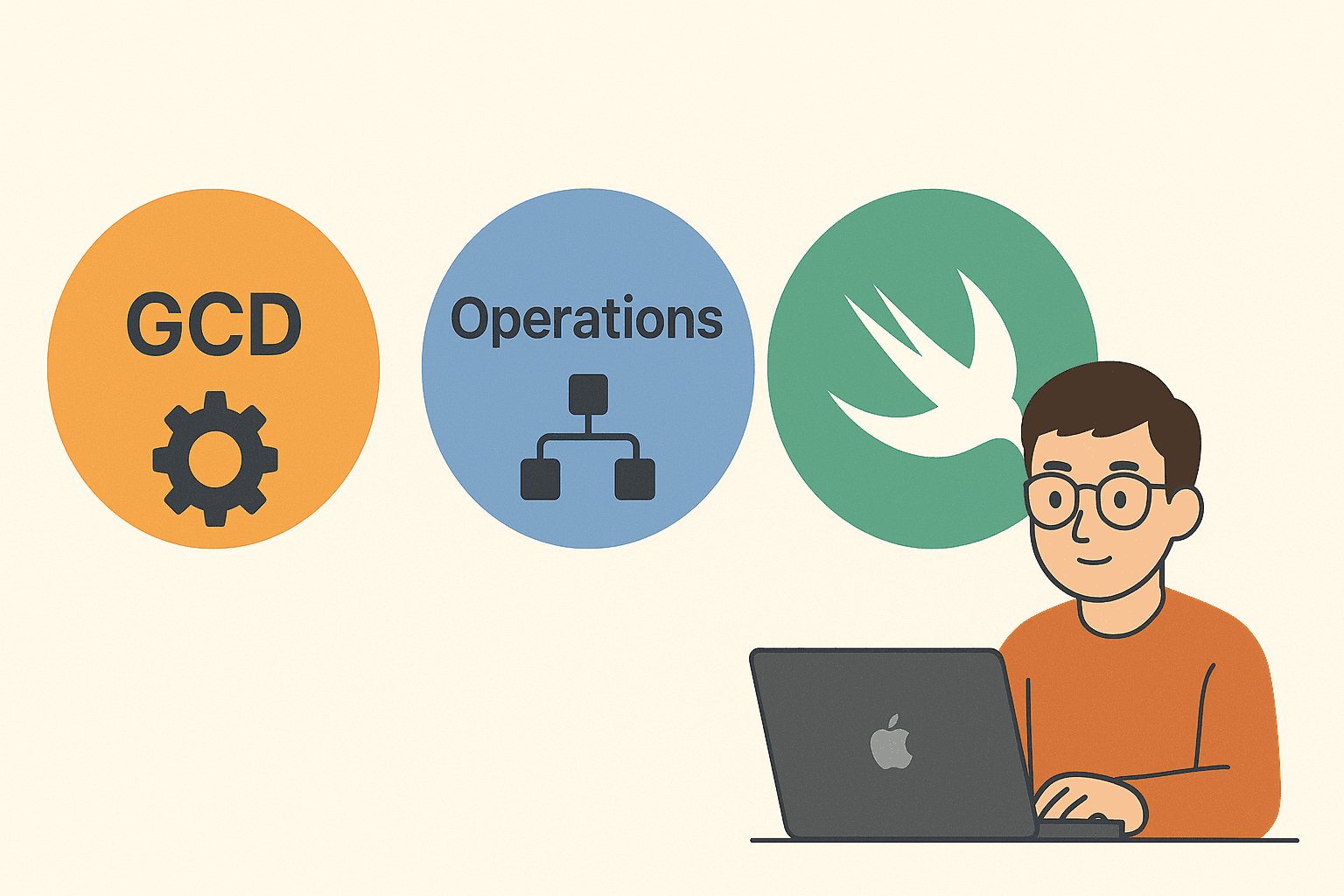
So you’re building an iOS app and need to run something in the background — maybe fetch data, resize images, or perform some heavy lifting without freezing your UI. And suddenly you’re staring at three different tools: GCD, OperationQueue, and the shiny new Swift Concurrency with async/await.
Which one should you pick? 🤔
Does choosing the wrong one mean your app will explode? (Not quite… but your brain might.)
In this article, we’ll break down the differences between these concurrency tools in Swift — when to use GCD, when to go with OperationQueues, and when Swift Concurrency makes your life easier. No fluff, no overengineering — just practical explanations and guidance that’ll make you go, “Ah, that makes sense now.”
Let’s untangle the mess — one queue at a time 🧵🚀
🧵 What Is GCD and When to Use It
GCD, short for Grand Central Dispatch, is Apple’s low-level concurrency framework. Think of it as the OG background task master in iOS. It lets you offload work to background queues so your main thread (and users) don’t suffer.
You’ve probably seen code like this a dozen times:
DispatchQueue.global().async {
    // Do heavy work here
    DispatchQueue.main.async {
        // Update UI here
    }
}
🛠 When Should You Use GCD?
Use GCD when you need lightweight, no-frills concurrency and:
- You just want to run a background task and come back to the main thread
- You’re performing UI updates, disk I/O, or downloading files
- You don’t need to worry about cancelling tasks or setting dependencies
- You want low overhead and fast performance
It’s great when you need something done quickly and dirty — like a one-time file copy or making an API call in the background.
✅ Pros
- Extremely lightweight and fast
- Easy to use for simple use cases
- Built right into the system — no need to import anything
❌ Cons
- No built-in task cancellation
- No task dependencies or prioritization beyond QoS
- Can get messy fast if overused — think nested async hell 🔥
🧱 What Is OperationQueue and When to Use It
If GCD is the fast-and-furious thread ninja, OperationQueue is the more refined, object-oriented cousin — still powerful, but with a little more structure and formality. It’s built on top of GCD but gives you more control over how tasks are executed.
Instead of tossing work into a queue and hoping for the best, OperationQueue lets you encapsulate tasks in Operation objects, manage dependencies, and even cancel them if needed.
let queue = OperationQueue()

let operation = BlockOperation {
    print("Doing some work in the background 🧠")
}

queue.addOperation(operation)
🛠 When Should You Use OperationQueue?
Use OperationQueue when you want:
- Task dependencies (e.g., don’t start B until A finishes)
- Cancellable tasks
- More control over task state and priority
- Better encapsulation — especially when using Operation subclasses
- Cleaner structure in apps with a lot of async workflows
It’s especially handy in cases like:
- Image processing pipelines 🖼️
- Queued network operations 🌐
- Tasks that should be paused/resumed/cancelled depending on app state
✅ Pros
- Supports task cancellation
- Easy to create dependencies between tasks
- Better debugging and testability for async work
- Cleaner structure for medium-complexity operations
❌ Cons
- Slightly more verbose than GCD
- Overkill for fire-and-forget background tasks
- Still based on GCD under the hood, so some complexity remains
⚙️ What Is Swift Concurrency (async/await) and When to Use It
Swift Concurrency, introduced in Swift 5.5, is Apple’s modern, structured way of handling asynchronous code — with async, await, Task, and Actors leading the charge. Think of it as Apple finally saying: “You know what? Enough with callback pyramids and deeply nested dispatch queues. Let’s make this readable.” 🧘♂️
Here’s what it looks like in action:
func fetchData() async {
    let data = try await networkManager.getData()
    updateUI(with: data)
}
Simple, readable, and no more juggling dispatch queues or creating operation subclasses like you’re assembling IKEA furniture.
🛠 When Should You Use Swift Concurrency?
Use Swift Concurrency when:
- You want structured, safe, and modern async code
- You’re working with new Swift APIs (Apple is all-in on async/await)
- You need better error propagation with try/await
- You care about readability, testability, and maintainability
- You’re building apps targeting iOS 15+ (this is a must!)
It’s especially useful in:
- Networking tasks 🌐
- Async workflows with multiple steps
- Situations where task cancellation and priority matter
Task {
    await viewModel.loadData()
}
It feels almost synchronous, but it’s not — that’s the magic 🪄
✅ Pros
- Most readable async code to date
- Built-in support for cancellation and structured concurrency
- Makes error handling elegant with try/await
- Plays well with SwiftUI, Combine, and modern Swift codebases
❌ Cons
- Requires iOS 15+, so no backward compatibility with older OS targets
- You may still need to drop into GCD/Operations for edge cases
- Learning curve if you’re coming from callback/GCD-heavy codebases
Simple, readable, and no more juggling dispatch queues or creating operation subclasses like you’re assembling IKEA furniture.
🧠 If you’re new to async/await, check out Mastering Async/Await in Swift — A Beginner’s Guide to build a solid foundation before going deeper.
**Mastering async/await in Swift: A Beginner’s Guide to Modern Concurrency (Part 1)** _Confused by Swift’s async/await? Learn the basics of async/await, how it improves your Swift code, and how to get…_medium.comhttps://medium.com/swift-pal/mastering-async-await-in-swift-a-beginners-guide-to-modern-concurrency-part-1-88cdb659ac3b
Next, let’s compare all three side by side and answer the question you’re really here for: “So… which one should I actually use?” 👀
⚔️ GCD vs OperationQueue vs Swift Concurrency — A Real-World Comparison
Now that we’ve walked through each tool individually, it’s time to compare them side by side. Because let’s be honest — you’re not here to collect trivia; you’re here to make better decisions in your code.
Here’s how they stack up in a real-world, no-nonsense comparison:
🧠 Simplicity
- GCD: ⭐⭐⭐⭐☆ — Great for small tasks, but can lead to callback hell if overused.
- OperationQueue: ⭐⭐☆☆☆ — Slightly verbose and needs boilerplate, but more structured.
- Swift Concurrency: ⭐⭐⭐⭐⭐ — Very readable and modern with async/await.
❌ Task Cancellation
- GCD: Not built-in. You’ll have to manually manage cancellation logic.
- OperationQueue: ✅ Supports cancellation via cancel() on operations.
- Swift Concurrency: ✅ Natively supported with Task cancellation and cooperative checks.
🔗 Task Dependencies
- GCD: ❌ Manual chaining using multiple nested calls.
- OperationQueue: ✅ Built-in using addDependency().
- Swift Concurrency: ✅ Structured with async let, TaskGroup, etc.
📦 Encapsulation
- GCD: ❌ Not object-oriented, more procedural.
- OperationQueue: ✅ Allows encapsulating logic in custom Operation subclasses.
- Swift Concurrency: ✅ Structured functions and Task objects promote modular code.
🧪 Testability
- GCD: 😬 Awkward to test directly, especially with nested closures.
- OperationQueue: ✅ Easier to mock and inject in unit tests.
- Swift Concurrency: ✅ Readable, and async functions integrate well in unit tests.
🧰 API Friendliness
- GCD: Works well with legacy APIs.
- OperationQueue: Great for bridging with both GCD and object-oriented code.
- Swift Concurrency: Ideal for modern Swift APIs and newer Apple frameworks.
🧭 Use Case Fit
- GCD: Great for quick async tasks, like background UI updates or I/O.
- OperationQueue: Best when you need queued or cancellable background work.
- Swift Concurrency: Ideal for structured async workflows, networking, data fetching, etc.
📱 Minimum iOS Support
- GCD: iOS 4.0+ — it’s ancient and universal.
- OperationQueue: iOS 4.0+ — also widely supported.
- Swift Concurrency: iOS 15+ — the tradeoff for all that async sugar 🍬
🤝 When They Work Together
Sometimes, it’s not an either/or. You can:
- Use Swift Concurrency with GCD behind the scenes (e.g., bridging to legacy code)
- Wrap Operations inside Task for progressive migration
- Use GCD for fine-grained control in performance-critical sections
It’s less about choosing a favorite and more about choosing the right tool for the task.
💡 Want to dive deeper into Swift Concurrency’s quirks like task cancellation and priorities? Check out Part 3 of Mastering Async/Await.
**Mastering async/await in Swift: Advanced Patterns, Cancellation, and Gotchas (Part 3)** _Take your Swift concurrency skills to the next level — learn how to manage tasks, handle cancellations, debug async…_medium.comhttps://medium.com/swift-pal/mastering-async-await-in-swift-advanced-patterns-cancellation-and-gotchas-part-3-af1ea8996145
🧭 Choosing the Right Tool — A Decision Guide
Okay, so you’ve seen what each tool does. Now let’s cut to the chase: Which one should you actually use in real-world iOS development?
Here’s your no-nonsense cheat sheet:
✅ Use GCD when…
- You need quick, simple background tasks
- You’re updating the UI after a background operation
- You want to fire off a task and forget it
- You’re dealing with legacy codebases where GCD is already in place
Example: Fetching an image in the background and updating the UI
DispatchQueue.global().async {
    let image = downloadImage()
    DispatchQueue.main.async {
        imageView.image = image
    }
}
✅ Use OperationQueue when…
- You want more control over tasks (pause, resume, cancel)
- You need to define dependencies between tasks
- You’re building a queue-based workflow (like batch processing)
- You prefer object-oriented encapsulation of tasks
Example: Downloading multiple files in sequence where file B starts only after A finishes
let op1 = BlockOperation { downloadFileA() }
let op2 = BlockOperation { downloadFileB() }
op2.addDependency(op1)

let queue = OperationQueue()
queue.addOperations([op1, op2], waitUntilFinished: false)
✅ Use Swift Concurrency when…
- You’re working in iOS 15+ and want clean, readable async code
- You’re writing new code or migrating from legacy GCD
- You care about structured concurrency, cancellation, and safety
- You’re using modern Swift APIs and frameworks
Example: Fetching data in SwiftUI using async/await
Task {
    do {
        let result = try await networkService.getData()
        viewModel.items = result
    } catch {
        print("Oops: \(error)")
    }
}
💡 Still wondering how Task, cancellation, and TaskGroup work in practice? Head over to Part 3 of Mastering Async/Await for hands-on examples and gotchas to avoid.
**Mastering async/await in Swift: Advanced Patterns, Cancellation, and Gotchas (Part 3)** _Take your Swift concurrency skills to the next level — learn how to manage tasks, handle cancellations, debug async…_medium.comhttps://medium.com/swift-pal/mastering-async-await-in-swift-advanced-patterns-cancellation-and-gotchas-part-3-af1ea8996145
Each of these tools has its sweet spot. And while Apple is clearly nudging us toward Swift Concurrency, the other two still hold their ground in the right contexts — especially when dealing with older iOS versions or legacy code.
🏁 Conclusion
Concurrency in Swift used to feel like trying to herd cats with spaghetti — but not anymore. With GCD, OperationQueue, and now Swift Concurrency, Apple’s given us a toolkit where each tool fits a different kind of job.
To recap:
- Use GCD when you want something fast and light.
- Use OperationQueue when you need structure, dependencies, or cancellation.
- Use Swift Concurrency when you’re going modern, clean, and scalable (and targeting iOS 15+).
You don’t have to pick a favorite forever — real-world projects often mix and match. The real win is knowing when to use what and why. And hey, if your current codebase looks like spaghetti, don’t worry — we’ve all shipped that 🍝
🔗 If you found this helpful, you might enjoy:
Mastering Async/Await in Swift — Part 1
Real-World Examples of Async/Await — Part 2
Race Conditions vs Deadlocks Explained
🎉 Enjoyed this article? Your support means the world to me!
💬 Drop a comment below! I love hearing about your experiences and answering questions
🎬 Subscribe on Youtube and become early subscribers of my channel: https://www.youtube.com/@swift-pal
💼 Let’s connect on LinkedIn for more professional insights: https://www.linkedin.com/in/karan-pal
Happy coding! 🚀
New articles, straight to your inbox.
No spam, no filler — just new writing on iOS, the web, and AI when it ships. Unsubscribe anytime.
Keep reading
Your CPU Has More Cores Than Your Job Can Use
Some work splits cleanly across hundreds of cores. Other work is a chain of steps where every new step has to wait for the last one to finish.
ReadYour Password Isn’t as Random as You Think
Crack-time calculators measure the size of a theoretical password space—not how people actually choose passwords or how attackers search them.
Read